
Introduction
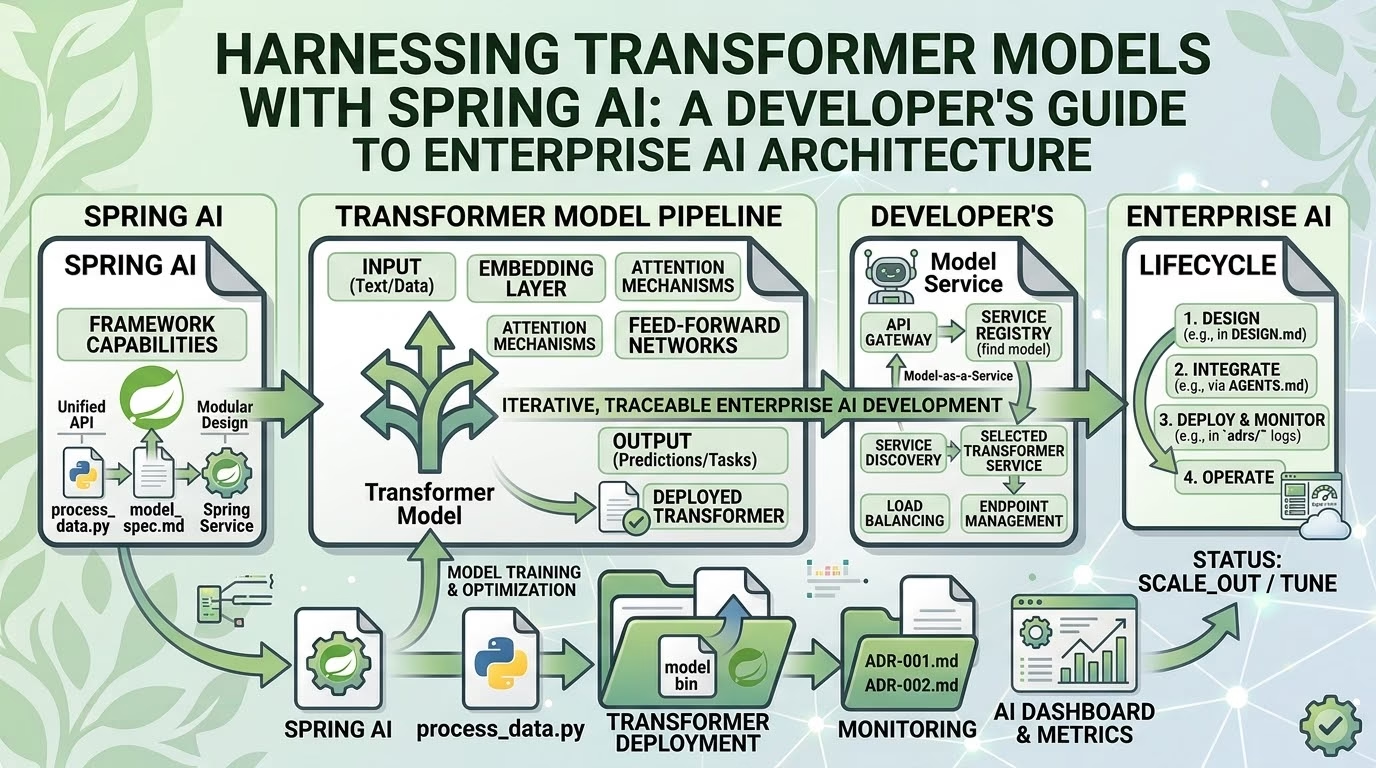
Since the groundbreaking 2017 paper “Attention Is All You Need” introduced the Transformer architecture, deep learning and natural language processing (NLP) have experienced a monumental shift. From Large Language Models (LLMs) like GPT-4, LLaMA, and Claude to specialized embedding models like BERT and MiniLM, Transformers form the bedrock of modern artificial intelligence.
Historically, the AI development ecosystem was heavily dominated by Python. However, enterprise software infrastructure is overwhelmingly built on Java. Spring AI bridges this gap, giving Java developers native, idiomatic tools to integrate, orchestration, and deploy Transformer-based models seamlessly into enterprise applications.
This article explores how Spring AI interacts with Transformer architectures—from cloud-hosted LLM endpoints to locally executed Transformer models using Ollama and ONNX runtime—and demonstrates how to build production-ready AI pipelines in Java.
1. What is Spring AI?
Spring AI is an extension of the Spring ecosystem designed to simplify AI application development without forcing developers to learn Python or rewrite legacy enterprise stacks.
Rather than implementing neural network backpropagation or tensor matrix multiplication directly in Java, Spring AI provides high-level portable abstractions over Transformer capabilities:
ChatModel&ChatClient: Unified interfaces for text-to-text Transformer models (OpenAI, Anthropic, Ollama, AWS Bedrock, Google Vertex AI).EmbeddingModel: Standardized contracts for generating dense vector embeddings using Transformer encoders (BERT, OpenAI Embeddings, Hugging Face).VectorStore: Native integrations with vector databases (Pgvector, Pinecone, Qdrant, Milvus) to persist and query Transformer-generated embeddings.- Function Calling: Automatic tool execution that allows Transformers to invoke enterprise Java methods seamlessly.
2. Architectural Blueprint: How Spring AI Interacts with Transformers
To understand how Spring AI utilizes Transformers, we can categorize execution into two main patterns:

- Remote Inference (API-Driven): Spring AI marshals prompts and context into structured JSON, sends HTTP/gRPC payloads to cloud-hosted Transformer clusters (e.g., OpenAI GPT-4, Anthropic Claude 3), and parses token-streamed responses back into Java domain objects.
- Local Inference (In-Process / On-Premise): Spring AI hooks into local runtimes such as Ollama or ONNX Runtime, allowing developers to run Transformer models (e.g., Llama 3, Mistral, ONNX BERT variants) entirely on local hardware or private enterprise servers.
3. Step-by-Step Implementation
Let me demonstrate how to set up a Spring Boot application that leverages Transformer models for both conversational AI and semantic vector embeddings using Spring AI.
Maven Dependencies (pom.xml)
<dependencies>
    <!-- Spring Boot Starter Web -->
    <dependency>
        <groupId>org.springframework.boot</groupId>
        <artifactId>spring-boot-starter-web</artifactId>
    </dependency>

    <!-- Spring AI Ollama Starter for Local Transformers -->
    <dependency>
        <groupId>org.springframework.ai</groupId>
        <artifactId>spring-ai-ollama-spring-boot-starter</artifactId>
    </dependency>

    <!-- Spring AI Vector Store (Pgvector Example) -->
    <dependency>
        <groupId>org.springframework.ai</groupId>
        <artifactId>spring-ai-pgvector-store-spring-boot-starter</artifactId>
    </dependency>
</dependencies>

<dependencyManagement>
    <dependencies>
        <dependency>
            <groupId>org.springframework.ai</groupId>
            <artifactId>spring-ai-bom</artifactId>
            <version>1.0.0-M1</version>
            <type>pom</type>
            <scope>import</scope>
        </dependency>
    </dependencies>
</dependencyManagement>
Application Configuration (application.yml)
Configure the local Ollama Transformer engine running llama3 for chat and nomic-embed-text for vector generation:
spring:
  application:
    name: spring-ai-transformer-demo
  ai:
    ollama:
      base-url: http://localhost:11434
      chat:
        options:
          model: llama3
          temperature: 0.7
      embedding:
        options:
          model: nomic-embed-text
Constructing the Service Layer (TransformerService.java)
Here, we use ChatClient (Spring AI’s fluent API) and EmbeddingModel to query the Transformer models.
package com.example.ai.service;

import org.springframework.ai.chat.client.ChatClient;
import org.springframework.ai.embedding.EmbeddingModel;
import org.springframework.ai.embedding.EmbeddingResponse;
import org.springframework.stereotype.Service;

import java.util.List;

@Service
public class TransformerService {

    private final ChatClient chatClient;
    private final EmbeddingModel embeddingModel;

    public TransformerService(ChatClient.Builder chatClientBuilder, EmbeddingModel embeddingModel) {
        this.chatClient = chatClientBuilder.build();
        this.embeddingModel = embeddingModel;
    }

    /**
     * Sends a prompt to the Transformer Decoder model (e.g., Llama 3)
     */
    public String generateResponse(String userPrompt) {
        return this.chatClient.prompt()
                .system("You are an expert AI software architect operating inside a Spring Boot system.")
                .user(userPrompt)
                .call()
                .content();
    }

    /**
     * Uses a Transformer Encoder model to convert text into high-dimensional vector embeddings.
     * The output represents the semantic position in vector space $V \in \mathbb{R}^d$.
     */
    public List<Double> generateEmbedding(String text) {
        float[] floatArray = this.embeddingModel.embed(text);

        // Convert float array to Double list for API responses
        Double[] doubleArray = new Double[floatArray.length];
        for (int i = 0; i < floatArray.length; i++) {
            doubleArray[i] = (double) floatArray[i];
        }
        return List.of(doubleArray);
    }
}
4. Advanced Pattern: Retrieval-Augmented Generation (RAG) with Transformers
Transformers have a finite context window and lack knowledge of proprietary enterprise databases. To solve this, Spring AI enables RAG (Retrieval-Augmented Generation) using Transformer Encoder embeddings alongside Vector Databases.
Mathematical Underpinnings of Similarity Search
When a document $D$ and query $Q$ are processed through a Transformer embedding model, they yield dense vectors $\mathbf{v}_D, \mathbf{v}_Q \in \mathbb{R}^d$. Spring AI calculates similarity using Cosine Distance:$$\text{Similarity}(\mathbf{v}_Q, \mathbf{v}_D) = \frac{\mathbf{v}_Q \cdot \mathbf{v}_D}{\Vert{}\mathbf{v}_Q\Vert{} \Vert{}\mathbf{v}_D\Vert{}} = \frac{\sum_{i=1}^{d} v_{Q,i} v_{D,i}}{\sqrt{\sum_{i=1}^{d} v_{Q,i}^2} \sqrt{\sum_{i=1}^{d} v_{D,i}^2}}$$
Implementing RAG in Spring AI
package com.example.ai.controller;

import org.springframework.ai.chat.client.ChatClient;
import org.springframework.ai.chat.client.advisor.QuestionAnswerAdvisor;
import org.springframework.ai.vectorstore.VectorStore;
import org.springframework.web.bind.annotation.*;

@RestController
@RequestMapping("/api/rag")
public class RagController {

    private final ChatClient chatClient;

    public RagController(ChatClient.Builder builder, VectorStore vectorStore) {
        this.chatClient = builder
                // Automatically embeds user query, retrieves relevant vectors, and appends to context
                .defaultAdvisors(new QuestionAnswerAdvisor(vectorStore))
                .build();
    }

    @PostMapping("/ask")
    public String askWithContext(@RequestBody String question) {
        return this.chatClient.prompt()
                .user(question)
                .call()
                .content();
    }
}
5. Local Transformers via ONNX Runtime in Java
For enterprise scenarios where data cannot leave the private network and running an external daemon like Ollama is discouraged, Spring AI supports ONNX Runtime (Open Neural Network Exchange).
This enables Spring AI to load quantized Transformer models directly inside the JVM process memory space:
- Transformer weights (
.onnxmodel files) are loaded into native C++ bindings via ONNX Java API. - Tokenization is handled directly through Java tokenizers (e.g., Hugging Face Tokenizers).
- Forward propagation runs on host CPU (using AVX-512 / NEON optimizations) or local CUDA GPUs.
6. Enterprise Best Practices for Spring AI and Transformers
- Structured Output Converters: Transformers return raw strings. Use Spring AI’s
BeanOutputConverter<T>to deserialize Transformer text output directly into strongly typed Java Records or DTOs. - Circuit Breakers & Resilience: Wrap Transformer API calls with Spring Cloud CircuitBreaker (Resilience4j) to prevent cascading failures during API rate-limiting or latency spikes.
- Observation and Metrics: Spring AI integrates directly with Micrometer and Spring Boot Actuator, allowing telemetry collection on prompt token counts, completion token counts, and Transformer inference latencies directly in Grafana.
- GraalVM Native Images: Compile Spring AI services into native binaries using GraalVM for near-instant startup times and ultra-low RAM footprint in Kubernetes environments.
Conclusion
Spring AI fundamentally transforms how enterprise Java engineers interact with modern artificial intelligence. By decoupling model implementation from operational logic, Spring AI enables developers to swap, test, and orchestrate complex Transformer architectures—whether cloud-based LLMs or local ONNX Transformer embeddings—using the familiar, robust patterns of the Spring framework.
Share this:

Discover more from GhostProgrammer - Jeff Miller
Subscribe to get the latest posts sent to your email.